
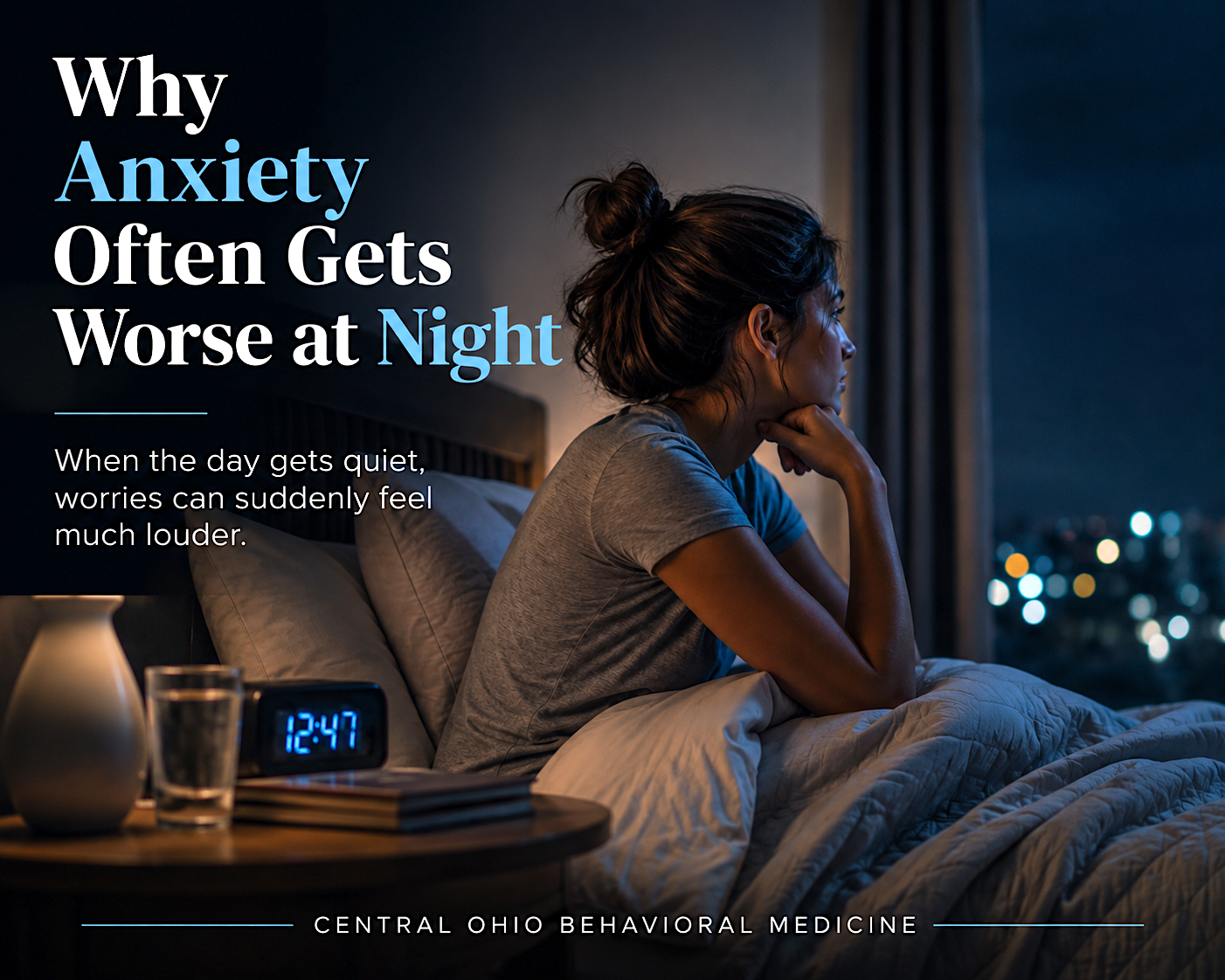
There is something about nighttime that can make worries feel bigger.
During the day, there are emails to answer, people to talk to, places to go, and things that need our attention. Then the day ends. The house gets quiet, the distractions disappear and suddenly there is a lot more room for our thoughts.
For people struggling with anxiety, this can be one of the hardest parts of the day.
A conversation from earlier gets replayed. A concern about work turns into worrying about next week. Something that seemed manageable at three in the afternoon suddenly feels much more serious at midnight.
This is something we hear often in psychiatry.
It doesn’t necessarily mean that anxiety is actually worse at night. Sometimes it simply becomes more noticeable. During the day, our attention is pulled in many different directions. At night, there may be very little competing with the thoughts that have been sitting quietly in the background.
Fatigue can make this harder. When we’re tired, it can be more difficult to step back from a worried thought and see it for what it is. Instead, one concern leads to another, and before long the mind is trying to solve problems that probably aren’t going to be solved at 1:00 in the morning.
Then another problem develops. We start worrying about the fact that we’re still awake.
“If I don’t fall asleep soon, tomorrow is going to be terrible.”
Now anxiety is not only keeping us awake. We’re anxious about being awake.
Occasional nights like this are part of being human. But when nighttime worry becomes frequent, interferes with sleep, or begins affecting how you feel and function during the day, it may be worth paying attention to.
Anxiety is treatable. Sometimes simply recognizing the pattern is an important first step. The thoughts that feel so urgent in the middle of the night often look very different in the light of morning.
Peter P. Zafirides, MD
Central Ohio Behavioral Medicine